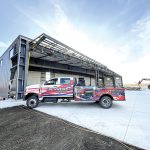
In a perfect world, all roofs would be installed on sunny days with temperatures between 35-75 F degrees. This is not always possible. And, as durable as metal and building materials are, they still need protection during storage and handling at construction sites in bad weather. To construct a quality building, you need quality materials,and these materials must be handled and stored correctly in bad weather to retain their quality.
Respect the elements
All four seasons provide challenges and opportunities for metal building construction. Metal roofs can be installed throughout the year provided it is not too rainy, frosty, icy, windy, hot or cold. While it is usually the busiest season for roof construction, summer is not always ideal. Excessive heat can fatigue workers. Temperatures on standing seam metal panels can and often do rise above ambient. Steel absorbs heat and the temperature can severely burn roofers.
“Usually, if temperatures are expected to rise above normal temperatures of 70-80 F, it would be wise to set scheduled work to begin long before sunrise,” says Jim Townsend, product manager, EXCEPTIONAL Metals, Saginaw, Mich. “Workers will see a ‘peak’ period in the day, usually around 1 p.m., at which the temperature will rise 60-80 F above ambient. Workers should plan to clean the area, store materials, and leave the job site prior to peak temperatures rising to a point of high risk during handling and installation. Footwear should provide the type of sole that avoids the feet from becoming burned from walking the panels.”
Summer and spring rain will always cause delays. “When you see lightning, you have to be careful and shut down,” says Terry Blount, roofing hoist designer at roofinghoist.com, Mobile, Ala.”Sometimes you really can get pushed to get a job done. If it is misty or light rain you can just work through it, but not heavy rain.” “Roofing contractors do not install standing seam in rainstorms and thunderstorms with or without lightning,” says Dave Rowe, product manager at Englert Inc., Perth Amboy, N.J. “Most standing seam material today has a Kynar coating with properties similar to Teflon designed to shed snow, dirt and debris. Rain makes the material more slippery and not suitable to work on. Working with metal standing seam panels in a thunderstorm is simply not done. Standing seam being cut, carried and installed during a lightning event would be extremely dangerous, like holding a metal golf club in the air. Professional safety experts recommend that any construction involving metal be halted until at least a half hour after thunder and lightning in a storm has stopped.”
Snow and high winds
Winter months don’t necessarily mean a shutdown in roof construction. Many roofing companies offer discounts for roofing jobs during the winter. Often, a snow- and ice-free roof can be 20-30 degrees warmer than the ground when the sun is out, but finding one in the winter is not always easy. “A contractor could conceivably shovel the snow off an existing roof, wait until whatever is currently on it to dry and then start installation of a standing seam product,” Rowe says. “Problem? By the time the roof dries out enough to reroof with metal, the daylight is nearly gone. Contractors never try to install a roof covered with ice.”
Additionally, “panels should be cleaned and free of snow or ice when raising them to the roof to avoid slippage and dropping of the panels as they are lifted and walked on during installation,”says Townsend. “Ice and snow build up on the metal panels at the roof should be treated with extreme caution due to sliding under normal foot traffic. Clearing the panels and wearing footwear designed to grip the steel panel is strongly recommended for all OSHA safety reasons.” In cold weather, installing panel clips and making sure they are positioned correctly gains importance.
“In cold weather, a metal roofing panel will be shorter than in hot-weather summer,” says James R. Kirby, AIA, associate executive director, National Roofing Contractors Association, Rosemont, Ill. “If you put the clips on incorrectly, you can actually have some crimping and oil canning.”
Windy weather can destroy panels by bending them during handling. Debris and dirt can get blown under the roof membrane onto exposed adhesives. High winds make cutting, carrying and installing standing seam roofs dangerous. “Because of their light weight and panel widths, standing seam panels can act like a kite,” Rowe says. “Wind can easily get under uninstalled panel or buffet it when it is carried, making it difficult or impossible to control. In any circumstance of high wind, the panel could be carried away by the wind, making it a dangerous airborne missile.”
Also, high winds can produce enough uplift forces to cause a complete roof blow-off. Keep metal panels dry Ironically, one of weather’s challenges to metal roof panels’ quality is moisture. Moisture’s impact on exposed metal roof panels before installation is quite different from its impact on them once they are installed. “One thing that we are concerned with is stagnant water,” says Kirby. “Ponding water is what we call it on the roof, stagnant water is what we call it when it is on a panel lying on the ground. On low-slope roofs you have ponded water in areas, which will evaporate over a couple of days, versus the water that runs to the drains on a steep-sloped roof. Water comes off of steep-sloped roofs. A roof is not intended to ‘hold’ water.”
When exposed to moisture and heat from bad weather, oxidation and paint peeling can occur on metal panels. With galvanized steel, a white powder-sometimes called white rust-will form on the zinc coating. To prevent this, once metal panels are delivered to customers, they should be stored indoors in a climate-controlled warehouse. They can be stored outside if necessary, but only for short periods of time.
Whether stored in a warehouse or on the ground outside, metal panels must be positioned correctly. Bundles should be placed on wooden skids at least 6 inches off the ground away from high-traffic and flood areas. Raising the panels high enough off the ground creates an airflow beneath the bundle. This inhibits ground moisture from condensing on the bundle’s underside. Tilting one bundle end higher than the other allows moisture drainage.
“Pre-formed panels need to be elevated, and they need to be approximately layered and angled to drain so that they don’t act like gutters and hold moisture,” Kirby explains. “Covering them and making sure they don’t get wet in bad weather would be the best way to do it. You need materials and packaging that allow for some breathability, you don’t want high condensation on stored panels. If you put the panels down on pallets and you use the right tarps, no problem.”
A loose-fitting waterproof tarp can protect bundles in rain and snow, and allows for air circulation and drying of condensed water. “Air should be allowed to move freely around the panels to avoid condensation,” Townsend notes. “Most people aren’t aware that panel finishes, like PVDF paint finishes, can dissolve if moisture is allowed to form and remain on the painted finish. Most manufacturers of PVDF paint finish will confirm that they take no liability for the finish if the panels were not stored properly prior to their installation.”
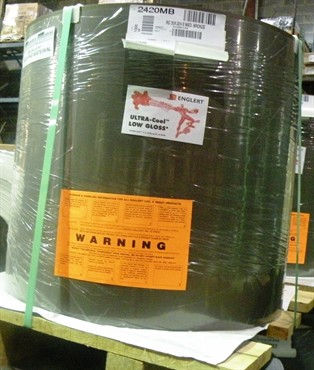
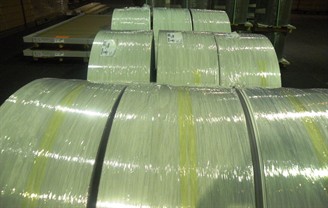
Metal panels frequently arrive at job sites with shrink-wrapped, factory-applied PVC plastic sheeting to protect them from bad weather, but it should be taken off very quickly after installation. “Plastic-coated metal sheets should not be exposed to direct sunlight for prolonged periods of time,” Rowe cautions. “Direct sunlight can ‘bake’ the protective plastic to the sheet metal.”
Frank Albert, owner and operator of Albert’s Specialty Roofing, a roofing contractor based in Richmond, Va., says “the main thing I’ve learned about site storage is to keep panels separated from each other. If they’re touching, they get wet and stay that way. Rust can form easily if the issue continues. Copper will turn color no matter what youdo, not too big a deal if the client is expecting it.
They have to know in advance it will lose its shine and go brown within days anyway. Whenever possible, I try to work at a place that has a garage or other shelter to keep my panels, or raw metal, dry. In the case of 1,000-pound rolls of copper, I sometimes take the metal to the shop for storage every night and weekends if it’s on a trailer. Also, 0.045 EPDM makes a good cover instead of plastic or tarps.” Regardless of the season or elements, roofers must respect the weather and not haphazardly handle building materials or endanger workers.
[sidebar]
Communicate about the criteria
Panel manufacturers and their paint suppliers should communicate the performance criteria of their products. “Each provider of materials mandates exactly how their materials are to be handled and stored in inclement weather: rain, lightning, snow and ice,” says Jim Townsend, product manager, EXCEPTIONAL Metals, Saginaw, Mich. “While most recommend the performance,safety and installation steps, each is different in how they recommend that procedure be initiated in the field. An example of this is protective sheeting that comes on metal panels. “Depending on how the film is installed on the actual panel, sometimes you have to take the film off right before you crimp the panel seams or after you crimp the panel,” says James R. Kirby, AIA, associate executive director, National Roofing Contractors Association, Rosemont, Ill. “It depends on the manufacturer.” Townsend advises general contractors, architects, construction managers and roofing contractors should get together prior to the start or design of a project to be brought up to date on methods, recommended procedures, storage and handling. When these steps are taken and monitored, the end result is usually the best result.
[sidebar]
Sealants and temperature range
Keep humidity, temperature and moisture in mind when using sealants and caulks. Cold weather delays activation and adhesion of roofing sealants. “A common mistake is roofers trying to seal in cold weather,” cautions John Pierson, PE, engineering services manager, The Garland Co. Inc., Cleveland. “For activation, temperatures should be 40 F and rising. Apply sealants to clean surfaces. They can be cleaned with an alcohol surfactant.”
Water-based caulks are not recommended for outdoor projects, because these products cannot withstand the hot-to-cold and cold-to-hot weather changes, as well as other harsh weather situations. On job sites where it is below 50 F during sealant application, use a silicone sealant instead of polyurethane, because polyurethane is very difficult to apply at this temperature. In cold weather, store sealants at temperatures of 60-80 F in insulated or heated storage boxes until application.
Very few sealants can be applied to wet surfaces, they exist, but they are hard to find. Make sure sealants are rated for exterior use or preferably roofing applications. They must handle the UV rays from the sun and freeze-thaw cycles, which can break down non-rated sealants within a few months causing them to lose their elasticity.