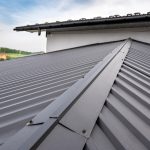
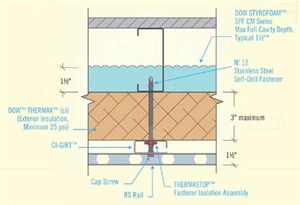
 For high-performance walls that manage moisture movement, consider exterior metal-framed walls designed using rainscreen principles. With the DOW-KNIGHT CI-System from Midland, Mich.-based Dow Building Solutions, contractors can easily build rainscreen metal framed walls, while designers benefit from the additional value of continuous insulation for improved energy efficiency, flashing and an air barrier in a four-in-one solution.
In rainscreen design, the exterior cladding sits away from the backup wall, creating an air cavity to help protect the building’s important weather-resistant barrier. By design, any moisture that does migrate through the cladding will easily drain down the cavity, away from the building. Air that flows between the cladding and the wall accelerates evaporation of any residual moisture
(Figure 1).
A properly designed rainscreen accommodates water penetration; it should not be confused with a weather-resistant barrier, which is just one component of a rainscreen and whose primary function is to provide barrier protection against water penetration. Instead, a rainscreen limits the amount of water that could potentially come into contact with the primary building envelope moisture barrier, to reduce the chance of water finding a way into the wall assembly.
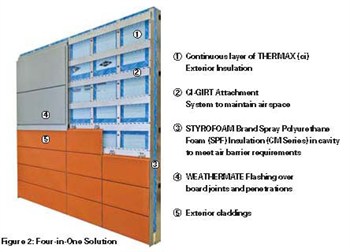 Four-in-One Solution
The DOW-KNIGHT CI-System delivers a systematic approach to achieving efficiency at every level: simplified design, streamlined construction and reduced energy consumption. The award-winning system addresses one of the biggest challenges facing designers: how to obtain continuous insulation (ci), especially with thick insulation, when attaching cladding without creating a thermal bridge. (Figure 2).
To maintain the required air space, the DOW-KNIGHT CI-System uses the CI-GIRT. This all-in-one cladding attachment, support and rainscreen cavity system lets a wide range of claddings be installed without thermal bridging. In addition, fasteners that penetrate the insulation are also isolated to further increase efficiency.
The unique design acts as a brace, working with the rigid insulation and fasteners for wind and cladding load resistance. This approach eliminates the need for a separate furring system that penetrates the insulation and may create a thermal bridge. The result is a wall system that delivers true continuous insulation. Because the claddings mount on the same sub-frame, multiple claddings can be used on the same building without altering the sub-frame or the primary building envelope.
The layer of rigid continuous insulation uses high R-value THERMAX (ci) Exterior Insulation to moderate the temperature of the wall cavity, and help reduce the potential for dew point condensation, mold and mildew. An integral, durable acrylic-coated aluminum facer provides a drainage plane and water-resistive barrier, eliminating the need for an extra step to install a membrane or building wrap. Up to 3 inches* of insulation (depending on the exterior veneer) can be used.
To further protect the wall from possible moisture entry, WEATHERMATE Flashing is used at through-wall penetrations, including over the insulation ship-lapped joints to help direct water drainage to the outside of the wall assembly. The butyl rubber adhesive flashing tape is self-sealing and self-healing to make installation quick.
Finally, to meet any air barrier requirements increasingly required by energy codes, STYROFOAM Brand Spray Polyurethane Foam
(SPF) Insulation (CM Series) is applied in the steel stud wall cavity to effectively block air infiltration by filling gaps, cracks and penetrations. With this insulation-as well as the rigid insulation-there is no need for batt insulation in the cavity.
Streamlined Construction
Contractors appreciate the ease of installation as no expensive tools are required to assemble the system, including the cladding attachment framing. Backed by two well-respected industry leaders, a complete package of installation videos and guides are available, as well as other free support tools such as CAD details, guide specifications and project profiles.
Here’s a quick snapshot of how the DOWKNIGHT CI-System is installed:
- Install the structural steel and exterior wall steel studs.
- Install and appropriately fasten each THERMAX (ci) Exterior Insulation board.
- Seal all end and edge joints and through-wall penetrations with WEATHERMATE Flashing.
- Install the STYROFOAM Brand Spray Polyurethane Foam Insulation
(CM Series). NOTE: Only trained and qualified personnel should install the spray foam insulation. - When the spraying job is completed, install the cladding attachment system with any of the approved veneers including terra cotta, stucco, metal composite metal, cladding, metal panel and fiber cement siding.
Construction can be streamlined. For example, once a portion of the rigid insulation is correctly installed and flashed, the rainscreen cladding attachment system can be installed. Once closed in, the insulated and weatherized envelope allows work to progress quickly on the building interior, speeding up the work of other trades beyond the exterior walls.
—
* Exact insulation thickness depends on specific cladding and wall assembly details per NFPA 285 fire approval
®™* Trademark of The Dow Chemical Company (“Dow”) or an affiliated company of Dow
—
Doug Todd is the market manager of commercial construction for Midland, Mich.-based Dow Building Solutions, North America. For more information, visit www.building.dow.com. For more information, including installation instructional videos, see building.dow.com/na/en/dowknightsolutions.