Metal Construction News asked several industry experts about thermal barriers in retrofit

Lee Durston, director of building science division. BRCA Inc., Tacoma, Wash.

Phil Effler, sales engineer, Technoform Bautec North America, Twinsburg, Ohio.
 Dan Harkins, CEO, Thermal Design Inc., Stoughton Wis.
MCN: What are the differences between thermal barriers for building retrofit vs. thermal barriers in new construction?
Dan Harkins: “Thermal barriers” are defined for the purposes of this roundtable as “insulation systems” that inhibit the transfer of heat energy through the building envelope, roof and/or wall assemblies.
Whether for new construction or retrofit applications, the basic requirements of insulation systems are generally the same, although in retrofit applications there may already be thermal breaks, air barriers and existing insulation, which are typically left in place and added to.
The major difference between a retrofit installation and a new installation is often installation from the interior. Obstructions on the floor typically set the pace. Experienced crews can whip through the retrofits fairly quickly if the floor area and wall areas are mostly clear of obstructions. Items attached to the ceilings and walls are usually fairly typical, predictable and generally easy to work with.
The decision to retrofit a thermal system into an existing building often is done for economic reasons and therefore the least expensive means to achieving the performance required becomes the most desirable option. Other factors, such as improving the interior appearance, improving acoustics, lighting systems redesign, solving interior condensation problems and others often provide added incentives to support interior retrofits. Reports of increased worker productivity, quieter working conditions, better lighting and more pleasant work environments often follow interior retrofits.
Lee Durston: In new construction you are able to carefully design the complete envelope system including the thermal barrier, whereas in a retrofit scenario you are looking to add a thermal barrier to an already existing system, which can prove to be more complicated. Any change made to the system thermally can have major impacts on the overall performance of all wall systems.
Phil Effler: Thermal barriers for retrofit require greater customization to meet the aesthetic and performance targets of the architect and building owner. Often, they use more complex profiles to accomplish these targets as well.
MCN: What are the most common types of thermal barriers for building retrofit today and how do they aid the building?
Durston: Thermal barriers or insulation can be broken down into four main categories: loose fill, blanket or batt, foams and boardstock. Loose fill insulation is made up of a loose pellet or fiber mix, and is blown into the building using special types of equipment. It can be synthetic, or made of a natural material like recycled cotton and wool from the fiber industries. There are also fiberglass and rock wool loose fill insulation, which are blown into the open stud cavities. Generally, loose fill types of insulation have R values of about R-3 to R-4 per inch of depth, while cellulose has about 30 percent more insulating value than a rock wool variety.
Blankets and batts are the least expensive types of insulation, and probably the most common. Made either from processed fiberglass or rock wool, they’re used to insulate the areas above ceilings, below floors and inside walls. R-values for this kind of insulation are about R-3 per inch in thickness. Rigid board can be made from polyurethane, fiberglass or polystyrene. This substance comes in many thicknesses and has an extremely high insulating value of about R-4 to R-8 per inch of thickness.
Foam insulation comes as a two-part liquid: the polymer and the foaming agent. Usually, the polymer in this case is a modified urethane, or a polyurethane. This liquid is sprayed into the cavities in walls, ceilings and floors, and expands during application, becoming a solid plastic filled with lots of tiny air-filled cells. This makes it easy to fill unusual spaces. Installing insulation of this type must be done by a professional with dedicated equipment for mixing, measuring and spraying.
Foam insulation costs more than traditional batt insulation, but can be cost effective anyway due to ease of installation and the air sealing benefits that are inherent with this product.
Harkins: One of the most common and most cost-effective types of “retrofit thermal barriers” is a fabric liner system that spans building bay (beneath the purlins) on a support strap platform and is sealed to the perimeter structure. These are very economical, lightweight, flexible materials, which makes them easy to install. The fiberglass or cellulose insulation is simply installed on top of the liner system to finish the installation. It’s a similar concept in the walls. A single-piece, flexible, fabric liner spans the width from column to column and floor to ceiling (inside plane of girts), and is mechanically fastened and sealed. Both the roof and wall retrofit is done on the building interior keeping the original metal panels on the exterior of the structure.
The fabric liner systems provide a superior sealed system to the roof and the walls, which is not practical to achieve with faced fiberglass insulation. This is because of all of the seams and extra materials and labor required to effectively seal all seams. These are very common, effective and some of the least expensive systems to increase the thermal performance of the building envelope.
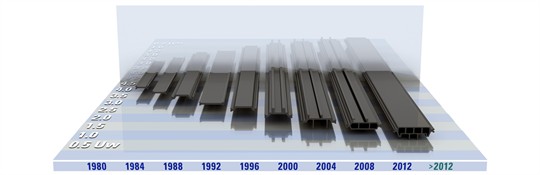
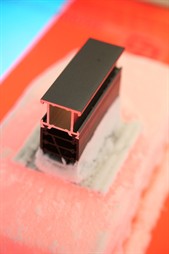
Effler: Thermal barriers made from polyamide are the most common type used today. With approximately 90 percent of the market globally, polyamide thermal barriers are used to help improve the efficiency of fenestration products around the world. Thermal barriers work by reducing energy transfer through an aluminum frame, which also improves resistance to condensation.
One of the most important criteria in building retrofit today, regardless of geography, is energy efficiency. Due to the high ranking of energy efficiency, polyamide structural insulating strips in aluminum windows are the preferred systems. These systems offer both customized designs and high energy-efficient performance.
MCN: How are retrofitted metal buildings’ energy efficiency and LEED standings affected by thermal barriers?
Effler: Thermal barriers decrease the overall energy consumption of a building, which aids greatly in meeting the “Minimum Energy Performance” requirements for buildings pursuing LEED certification. Thermal barrier demand worldwide has increased dramatically over time and continues to do so every year. The use of thermal barriers in nonresidential buildings has continued to increase every year according to industry market studies, especially in the curtainwall and façade segment. These systems offer lower condensation on window and glass surfaces, and significant reductions of HVAC loads and building operations and maintenance costs.
Durston: By providing a thermal barrier in the building envelope you are able to thermally separate the indoor space from the outdoor space. The more effective the thermal barrier is, the less work has to be completed by the inside space conditioning system, such as mechanical heating and cooling. This translates to energy use reduction.
Harkins: There are a variety of areas within the LEED program where retrofitted thermal barriers come into play especially in metal buildings. For example, there are prerequisites for the minimum energy performance of buildings. Depending on the building’s age, the real insulation levels and the thermal barrier integrity may need to have improvements made. Making these improvements escalates the LEED points available when optimizing the building’s energy efficiencies to various tier levels. Most metal buildings have a huge opportunity for energy savings due to their obsolete insulation methods and drastically overstated performances.
Indoor air quality is another LEED area to be addressed where minimizing the amount of chemical emitting materials containing formaldehyde and other VOCs is of concern. Regional sourcing of materials and recycled content always plays a role in the design considerations in retrofit or new construction. Essentially anything coming in or coming out of the project site is considered with LEED and that directly impacts buying decisions.
If success is measured in the amount of LEED projects, then I would consider it a growing success. The number of LEED projects continues to grow and the immediate future seems to be very fruitful for those involved. Energy efficiency should be the first to be exploited however, as it provides a financial payback, as well as the simple environmental and social benefits.
MCN: Older buildings are more ventilated than today’s modern tightly enclosed buildings. Is this a challenge and what influence does this have when installing retrofit thermal barriers on them?
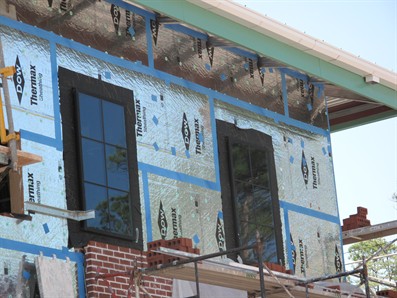
Effler: When considering a retrofit, essentially the building envelope is being buttoned up when the new system is installed. Specifically, thermal barriers involved in fenestration products will likely be used more, increasing the overall efficiency of the building envelope. Air infiltration is only a concern if products are installed incorrectly. Updated methods to address air infiltration include new barrier systems, such as spray-applied systems, which seal the building more effectively and address the window-to-wall interface. Aluminum systems with polyamide structural insulating strips contribute to higher structural performance. This also contributes to reducing air infiltration, which may cost a building up to 30 percent of its energy usage.
Durston: As we add or enhance thermal barriers in the building envelope we change the dynamics of the system. Some barriers can be vapor barriers that stop vapor diffusion, and if this occurs, vapor is allowed to condense in the wall system. Hygrothermal modeling, or vapor transition analysis, can be completed prior to new construction or renovation work to ensure issues like this will not be built into the building.
MCN: Are there any new codes, standards, laws or regulations affecting thermal barriers in building retrofit? What are they and what are their impacts?
Durston: Worldwide energy codes are acknowledging the need for increased insulation in buildings. It is not uncommon to see R-40 wall systems along with R-60 roofing systems. The danger in this is knowing how to properly design with these enhanced thermal barrier systems.
Effler: Energy codes have come a long way in the last 10 years and are continuing to become stricter. As more stringent energy codes become readily adopted by state and local governments, demand for high-performance thermal products will rise. Both retrofits and new construction are impacted by changes in building codes.
Harkins: More and more states have adopted and implemented newer energy codes such as the 2009 IECC (International Energy Conservation Code) where the levels of the thermal envelope have increased. Retrofitting may include bringing the thermal envelope up to current code levels. It is important to understand what the minimum intended requirements are of the new code and how it affects your specific project and design.
The new 2012 IECC takes steps further whereas the thermal envelope requirements increased even more than the 2009 version and perhaps more importantly, requires the use of an effective air barrier in most climate zones. The mandatory air leakage requirements outlined in the new code will push installers to be more meticulous with product installation. They’ll have to rely more heavily upon manufacturers and suppliers for technical guidance and for proper installation techniques to ensure a quality thermal and air barrier is achieved.
In terms of the ASHRAE Standard 90.1, a new addendum is anticipated to be approved and publicly available by the time this round table is published in August. This addendum is the popular
‘addendum bb’ where large steps towards energy efficiency have been incorporated for a variety of building elements regardless the type of building structure. This new addendum to the 90.1-2010 Standard is of specific interest to the metal building industry because it will incorporate for the first time, the revised Ufactors for the “traditional” single and double layer fiberglass assemblies as typically installed.
MCN: What is a “deep energy retrofit” for buildings and how are thermal barriers a part of it?
Durston: It is imperative to address the envelope’s thermal barrier during a deep energy retrofit. The largest part of a building’s energy usage is space conditioning. By increasing the thermal barrier, you are reducing the need for space conditioning reducing overall energy consumption.
Effler: The idea behind a deep energy retrofit is to reduce the overall energy a structure uses by taking a whole building approach. The built environment increasingly understands the importance of optimizing the energy efficiency of the building envelope before engineering the building systems and infrastructure. Except for the mildest climate zones, the use of thermal barriers apply very widely to the building envelope changes that are being made when doing a deep energy retrofit. Substantial improvements in whole building energy efficiency are only possible when the thermal performance of the glazing system is optimized.
Harkins: From what I understand, the term deep energy retrofit analyzes the building as a whole. It then looks for synergies within new and existing systems to exploit and take advantage of to help further reduce energy usage. Far too often in today’s market, contractors focus retrofitting on a component-by-component basis, rather than looking and implementing strategies that integrate total energy design savings. For example, next time your company has an opportunity for retrofitting the insulation in an existing building, also look for other areas the building owner can save energy. These could include more efficient HVAC, alternative doors or windows, automated controls for daylighting or occupancy, and a lighting upgrade. These are all areas to explore as a whole energy package that complements one another and works as a system, not a single component at a time.