 Where Salt Lake City and the Wasatch Mountain Range meet, there stands an architectural double entendre. Wrapped in copper and glass, the Natural History Museum of Utah rises out of the foothills as a gateway to Utah’s wildlife and a passage to Utah’s rich natural history.
Located on the University of Utah campus’ outskirts, the facility is responsible for the conservation of more than 1.2 million artifacts, while also functioning as a key venue for academic work and extensive graduate research through the university. The architectural goals for the building were to capture the museum’s mission statement, “to illuminate the natural world and the place of humans within it,” through both innovative design and sustainable initiatives.
Creating a physical representation of this mission was a challenge presented to Design Architect Todd Schliemann from the New York City-based studio Ennead Architects. In association with GSBS Architects, a local Salt Lake City firm, it was determined that the museum’s design demanded a deeper, more spiritual architectural experience.
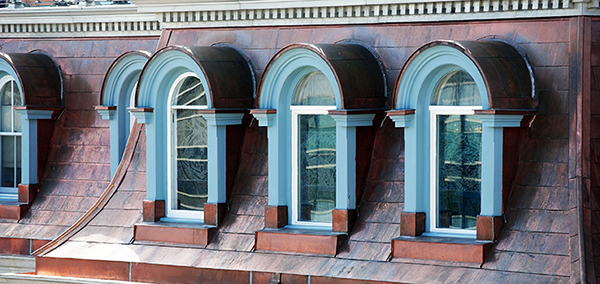
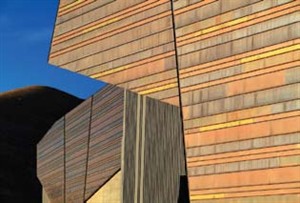 To pay homage to the land surrounding the museum, a native metal, copper, was selected for the facade of this 163,000-square-foot building. The copper was mined locally at Kennecott Utah Copper’s Bingham Canyon, which is less than 30 miles from the museum.
Schliemann drew inspiration from the mountains and valleys of the surrounding area and selected a standing seam copper cladding system because it replicates the stratified aesthetics of a canyon. The horizontal bands of different copper alloys were applied one on top of the other. Copper and two copper alloys (10 percent zinc/90 percent copper-commercial bronze and 15 percent zinc/85 percent copper-red brass) give the building a unique character.
The project earned a 2012 North American Copper in Architecture award from the copper industry recently. “We see many copper cladding projects from all over the U.S. and Canada, but few compare to this system,” says Andy Kireta Jr., vice president for the Copper Development Association (CDA). “The unique and creative mix of copper alloys and the attention to detail makes this project a stand-out in the industry.”
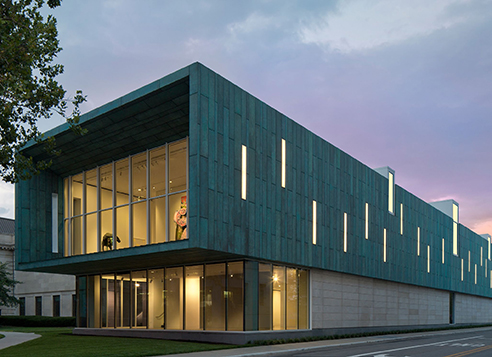 The 42,000 square feet of copper paneling seemingly weaves its way into the mountainside. The assimilation is uncanny and the copper detail also replicates the seasons. As the foliage of the region changes from red to green each year, so will the copper as it patinas over time.
“This museum is a testament to the evolution of Utah,” says Museum Director Sarah George. “Copper’s natural history is a reminder that the world around us continues to change every day.” The copper work helps fulfill the first part of the museum’s mission, “to illuminate the natural world,” but the second part, “and the place of humans within it,” is more subtly addressed by the design and construction.
The building is designed to achieve LEED Gold certification, and 25 percent of its physical composition is recycled materials. The construction process also integrated sustainable practices as more than 75 percent of the waste produced was recycled. That included 205 tons of wood, 154 tons of metal, 24 tons of plastic and cardboard, 1,086 tons of concrete and 2.1 tons of office supplies. “Sustainability is respecting the future,” says George. “And in order to preserve Utah’s natural history for future generations, we must commit to its protection.”
Though important, the issue of sustainability runs deeper than any LEED certification program. The museum lives by these standards and is aware that it will be looked upon as the example of environmental excellence for every similar project moving forward.
“Everyone is focused on sustainable design in today’s world, but the truth is that sustainable features are not always apparent. In fact, the best ones are not,” says Schliemann. “Although it is designed to achieve LEED Gold certification, this building does not need to wear sustainability on its sleeve. Much of what we did is not even recognized by the LEED rating; it is just the right thing to do.”
Wayne Seale, AIA, NCARB, is the program manager for the Copper Development Association, specializing in architectural applications. For more information about copper’s use in building applications, visit www.copper.org.
Photography: Jeff Goldberg, Esto