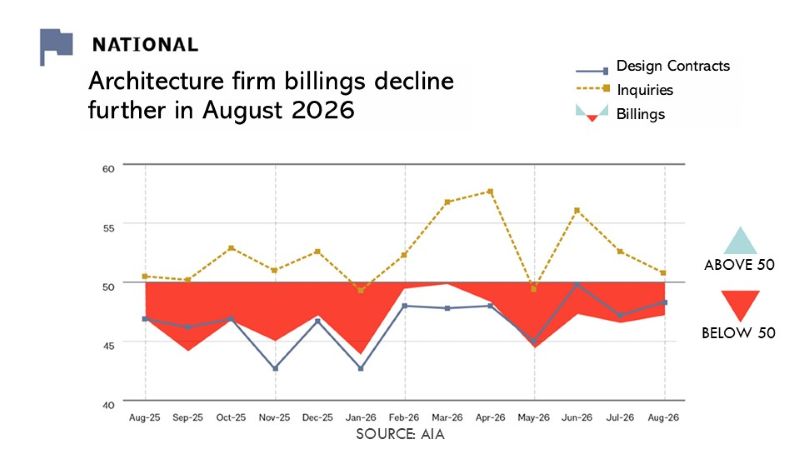
The AIA/Deltek Architecture Billings Index (ABI) score for August 2026 was 47.2. While slightly up from July’s score of 46.6, the majority of firms continued to see weak business conditions.
The ABI is a leading monthly economic indicator based on billings at U.S. architecture firms and is used to predict nonresidential construction activity 9 to 12 months in advance.
ABI scores greater than 50 indicate growth, while scores below 50 indicate contraction.
Inquiries into new projects showed only modest growth this month, while the value of newly signed design contracts continued to decline. Further, sentiment about future billings has weakened at architecture firms.
When AIA first asked about future billings at the end of Q1 2026, 31% of responding firm leaders indicated they expected billings to increase in the second quarter. That belief held steady when firms were asked about Q3 (30%), but expectations about Q4 have now fallen to 25%.
The share of responding firm leaders who expect billings to decline in the coming quarter has increased from 21% at the end of Q1 to 29% at the end of Q3, AIA added.
Despite billings declining overall, firms in some regions saw better conditions in August. Those located in the Midwest reported modest growth for the first time in nearly a year, while billings were essentially flat at firms located in the West.
At firms in the Northeast, billings softened significantly, reaching their lowest level since 2020.
Billings also varied significantly by firm specialization, as those with a commercial/industrial specialization saw a slight uptick. Despite firms with institutional and multifamily residential specializations seeing slight growth earlier this year, business conditions remained soft at firms of all other specializations.
After dropping by 100 positions in June, architectural services employment added 700 new positions in July (the most current data available).
— With files from AIA