A metal roof may be sold on longevity, but on many projects, the service life of the system is determined by one of the smallest components on the roof.
Panels, coatings, and profiles usually get attention, but when exposed-fastener metal roofs begin to show premature problems, the issue often traces back to the screw, the washer, or the installation.
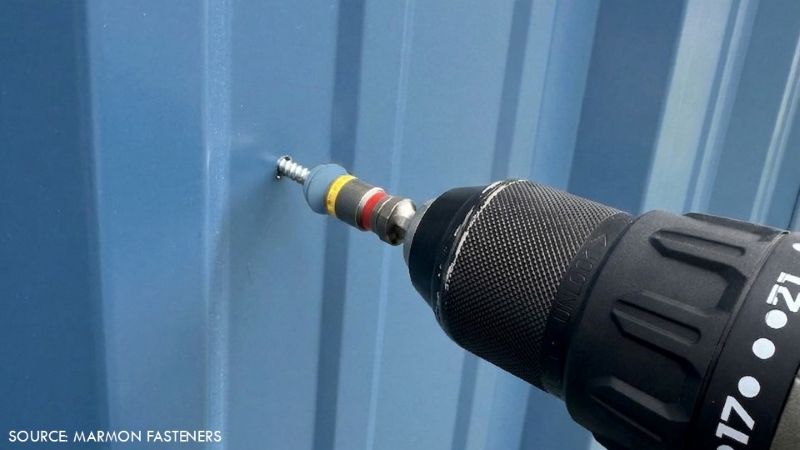
One of the most common field failures is fastener back-out caused by excessive torque during installation. When the screw is overdriven, the threads can strip the substrate or crush the washer, reducing holding power and allowing the fastener to loosen over time, often resulting in raised screw heads and early leak points.
For contractors, that reality is easy to overlook at bid time … and hard to ignore later. Fasteners typically represent less than 1% of a roofing project, yet they’re often the first place people try to save a few hundred dollars on a five-figure job.
That may improve the quote upfront, but it’s not much of a savings when the fastener becomes the first point of failure—especially when the cost to upgrade to a long-life fastener with a lifetime warranty is relatively small.
If you are installing an expensive metal roof, use a premium fastener. Moving from a standard roofing fastener to a long-life fastener is a small upgrade compared to the overall cost of the project, and that seemingly small decision can determine whether the fastener ages with the roof or becomes the maintenance issue that shows up years earlier than anyone planned.
In the field, fastener failure often appears as loosening, leaks at penetration points, or visible deterioration such as washer cracking or red rust on the fastener head. Any of these conditions can compromise the seal, allowing water intrusion long before the panels or coatings show signs of distress.
The bottom line is this: if you’re selling a roof that is expected to deliver decades of service, the fasteners you use should deliver the same long-term expectation.
Not brand, not price, but application
The first question in fastener selection is neither about brand nor price, but about application.
Metal-to-wood and metal-to-metal assemblies demand different designs, and treating them interchangeably can create problems that may not show up until well after the roof is installed.
For wood substrates, the fastening screw’s thread geometry must develop a strong pullout without destroying the fibers that provide the holding power. In steel, the point and thread design have to cut and engage cleanly enough to prevent stripping and incomplete bites.
When a fastener designed for steel is used in wood, the threads may not develop sufficient pullout resistance, leading to loosening as the roof cycles thermally. In steel, using a wood fastener can result in stripped holes or incomplete engagement, creating connections that feel tight on day one but gradually lose holding power in service.
The fastener has to match the substrate. You can, of course, drive in the wrong screw, but that does not mean you have a connection that is going to perform over time alongside the roof.
The washer … where the real trouble starts
Contractors know the screw must hold, but long-term performance is often won or lost at the seal.
In exposed-fastener roofing, the washer is doing more than finishing the assembly. It must stay resilient through UV exposure, heat, cold, moisture, and the constant expansion and contraction that comes with metal panels in service. A leak path begins when the sealing material hardens, cracks, shrinks, or loses compression.
Most exposed-fastener metal roofs rely on EPDM or similar elastomeric washers to form the primary seal. Under prolonged UV exposure and repeated thermal cycling, lower-quality washers can harden, shrink, or crack, reducing compression and creating a leak path. Dual-seal washer designs help maintain sealing pressure and provide redundancy as conditions change over time.
A lot of contractors still buy fasteners like they are just a commodity, but on a metal roof, the sealing system matters every bit as much as the thread. If that seal breaks down, you have created a vulnerability at every penetration.
For contractors selling metal as a premium system, that point carries real weight. A roof designed for decades of service should not depend on a sealing point that was treated like an afterthought.
Installation makes or breaks the system
Even the best-designed fastener cannot overcome poor installation. Over-driving can crush the washer and damage the seal before the crew leaves the site. Under-driving can leave the assembly insufficiently seated, allowing movement that enlarges the hole over time and stresses the sealing point.
Visually, an over-driven fastener often shows a crushed, split, or squeezed-out washer beyond the fastener head, while an under-driven fastener may leave the washer barely compressed or allow the panel to move around the screw. Both conditions are early warning signs that the connection will not perform in the long term.
On exposed-fastener roofs, those small inconsistencies are often where future maintenance starts. This is why contractors should think about fastener design and installation consistency in tandem, not separately.
Every manufacturer of metal roofing will tell you that “they never shipped a leak.” The best fastener in the catalog cannot fix a poor installation, but a well-designed fastener can absolutely help a crew get more consistent results, especially when paired with the right tools and good installation discipline.
The real cost question
Fasteners are often viewed as a quick cost-cutting opportunity, but that misses the bigger picture. When you look at the total roof package, the price gap between a standard fastener and a long-life solution is usually negligible.
What is not small is the cost of callbacks, leaks, repairs, and the hit to your reputation when the roof starts having issues because the attachment system was “value-engineered too far.”
On a typical metal roofing project, upgrading from a standard fastener to a long-life fastener may add only a few hundred dollars to the total material cost. By contrast, a single callback for leak investigation and repair can quickly exceed that amount, even before accounting for labor disruption, warranty exposure, or reputational damage.
Fasteners rarely get top billing in a metal roofing specification, but they can set the upper limit for how well the roof performs. For contractors, that means looking beyond length, diameter, and piece price.
Substrate compatibility, sealing performance, corrosion resistance, installation consistency, and service-life expectations all matter. And for manufacturers and suppliers, it means the long-life story must include the attachment system, not just the panel.
A metal roof is only as good as the fastener holding it down.
Don Bratcher is vice president of sales for OEM at Marmon Fasteners, leading sales strategy and execution for multiple brands, including Atlas. With more than four decades of industry experience, Don spent almost 30 years at Butler Manufacturing Company in various roles before joining Atlas Building Products 11 years ago. He then joined Marmon Fasteners in August 2025, leading the sales teams for OEM brands Atlas, Tenn-Tex, and Pan American. Throughout his career, he has focused on growing and maintaining customer relationships while selling quality products and services.