 Success in business can be measured in any number of ways, especially in the metal construction industry. Sales, square footage, tonnage, profit, etc. Often times the simplest, most-direct measureable to focus upon is growth. Over a given timeframe, growth is one of the surest signs of success. Using that criterion, BlueScope Steel’s success over the past six years is obvious. Through both organic- and acquisition-based growth, Blue- Scope Steel has shown itself to be an example of effective business strategies and shrewd decision-making, resulting in the largest metal building manufacturer on the planet.
The challenge, of course, is maintaining and even improving upon that leadership position in the face of a struggling economy. Even in these conditions, it seems BlueScope is ahead of the curve.
 Multiple Brands
Pat Finan, president, BlueScope Buildings North America, realizes that the company’s size is one of its key differentiators from the competition, but more important is how that advantage is capitalized upon.
“First and foremost, we’re the largest metal building company in the world,” he said. “Our geographical footprint extends not only across North America, but also into China,Southeast Asia, India, Saudi Arabia and Australia. However, in North America, one of our key differentiators is certainly our builder distribution—it’s the best builder distribution network in North America, with Varco Pruden Buildings and Butler Manufacturing having approximately 1,000 builders each in the marketplace.
To truly appreciate the distribution channels and the various brands under the Blue- Scope Steel umbrella, we must look back a few years. In 2004, BlueScope Steel acquired Butler Manufacturing, and then in 2008 it acquired the IMSA Steel businesses in the United States that included Steelscape, Metl-Span, ASC Building Products and Varco Pruden Buildings.
Beginning in 2008, the process of integrating the Varco Pruden and Butler Manufacturing businesses began as BlueScope Steel created BlueScope Buildings North America. This allowed the logical rationalization of certain administrative roles and production assets, while still maintaining a strong, brand-driven focus based on separate sales, marketing, customer service, pricing systems,and engineering groups. Key product differentiators for each brand’s roof systems, wall systems, and related trim systems remain separate and unique to each brand.
 “We typically don’t market BlueScope Buildings,” said Finan. “We continue to market the two main building brands—VP and Butler— and a few other smaller building brands, and we keep the businesses separate.”
But why keep these two metal building brand names separate? Why not go to market as the larger BlueScope Buildings?
“Both businesses were similar in nature in that they sold through builders via formal agreements,” added Finan. “They have very similar channels to market. Butler Builders and VP Builders are the largest network of professional building contractors out there with long-standing relationships with their building brands. Maintaining those channels and the two well-known brands gives us more opportunities in the marketplace than if we just had one. It gives us more cards in the deck, so to speak. If you rolled them into one you might not have as many opportunities.”
Given all of the growth and acquisition BlueScope experienced during the past few years, it became obvious that a certain amount of streamlining and integration was required to eliminate redundancies, improve efficiencies and adapt to a declining economy.
“We did want to take advantage of some synergies and efficiencies, so we looked at the manufacturing plants and engineering systems of both businesses, decided to adopt the best practices and processes, and merge them together,” said Finan.
 The resulting downsizing took the company from 13 to 10 production facilities in North America, and while the decisions were tough,based on improving efficiencies, and required investment (as demonstrated by the major expansions at two facilities—Visalia, Calif. (112,000 square feet and St. Joseph, MO, 62,000 square feet, the move also coincided with the economic downturn of late 2008.
“We started that toward the second half of 2008 and into 2009,” said Finan. “So, as the market began to decline, we accelerated those closures and got that work done during a difficult period of time. Some of it was strategic in nature; part of it was because of the market.”
Again, the end result was a leaner company more prepared to handle not only the tough times, but also poised to take advantage of the economic recovery, when it arrives.
“Through one engineering system and one manufacturing footprint, we can engineer and manufacture a multiple of building brands. The two primary ones being VP and Butler, and then there’s Liberty Building Systems and HCI Steel Building Systems. So we can produce any of those four brands at most of our plants. That strategy is very unique in North America amongst those players that use multiple brands, particularly when you consider how we’ve kept roof, wall and trim systems separate.”
 Vision Engineering System
That strategic, multi-brand mindset required a fully integrated engineering and manufacturing system, incorporating not only multiple brands, but multiple manufacturing facilities. The first such facility to produce products utilizing the company’s new Vision Engineering System was the plant in Visalia.
Scott Wilson, western region operations manager, BlueScope Buildings, is spearheading the integration—and in the case of the Visalia facility—that required a significant expansion. Beginning in January 2009 and completed in October 2009, the Visalia facility grew by 112,000 square feet to nearly300,000 square feet thanks to a capital investment of $14 million.
The Visalia plant stayed open and producing product while the expansion was under construction—no small feat. The facility maintained its production of Butler brand products while it phased in the other three building brands (VP, Liberty and HCI). With all four brands being produced in the same facility, a crucial part of this integration is the company’s Vision Engineering System.
“We consider that one of our fundamental competitive advantages,” said Wilson. “With our four brands, we looked at the best practices amongst each of the brands and how we go about designing our pre-engineered building systems. So we’ve taken the best processes of each of those brands and consolidated that into this new Vision Engineering System.”
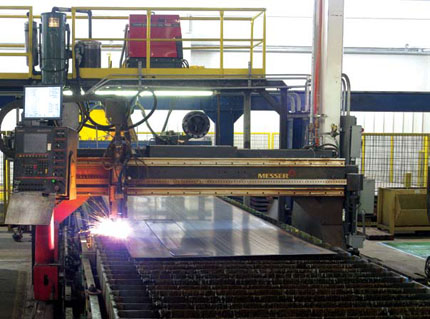
The Vision system affects every aspect of production, from design to engineering to manufacturing. This level of increased automation increases the efficiencies in project planning, material usage, engineering, manufacturing and the movement of data from one department to the other.
 “We’re in a very competitive environment and when we started this process of integrating the multi-brands, we wanted to look at the best practices amongst all four brands, how they produce product, and what’s the most efficient way to safely, with high quality, produce our products. And we looked to automation with that,” said Wilson.
“In the frame process, for example, we’re batching several orders together, we’re taking data directly out of our Vision Engineering System, passing it right through production control right to the workers in the factory. So our operators can focus on making quality products and not on passing data. In addition to that, it’s a safer process as well.”
Added Morrie Anderson, vice president, operations, BlueScope Buildings North America: “There’s one other piece to that, and that’s our ERP system. We’re going to a common platform—an Oracle-based system called Compass. Incorporated into that software package are some advantages we found from the various companies that had been developed over the years.”
“So it’s a fully integrated system,” said Finan. “The order is entered into Compass, passes through our Vision Engineering System and then directly onto manufacturing and the CNC machines.”
Simply put, Wilson believes BlueScope Building’s engineering system is the best in the industry.
“We’re very excited about that—it’s very flexible for engineering, it takes a lot of time and effort out of that so we can respond very rapidly. But also it passes information on to manufacturing, so we can optimize our manufacturing, minimize our cost, improve our yield, improve our throughput and improve our productivity.”
Safety & Training
Safety is not just paid lip service by BlueScope Buildings North America. It is of top priority and very much “in your face” as soon as you step foot into the Visalia facility. Everything is based on proper behaviors and a ‘zero-harm’ environment. Basically, it’s preventing accidents through conditioned processes.
“Safety is the foundation of what we do— it’s job one,” explained Wilson. “All discussions, all communications start with the safety contact. We believe we can operate in a ‘zeroharm’ environment. We follow the BlueScope Steel model for safety, and that’s largely modeled after the DuPont safety program— meaning that all accidents can be prevented. It’s based on behaviors and that drives every interaction with our employees, every process in the plant.”
Added Wilson: “We believe we have the best safety program. Our behavior-based safety program is second-to-none; and our zero-defect initiative targeting quality. We want to be the leader in quality products in North America.”
 Safety, of course, extends beyond the safe operation of equipment. It requires training,and when each worker is expected to do at least four jobs, proper training is imperative.
“We need very flexible employees. Our business model follows a construction schedule and is very seasonal and cyclical. So, to be very cost-effective with that, we have to be flexible with where we place our employees. That requires quite a bit of cross-training and training on how to safely operate our equipment to produce a zero-defect product,” said Wilson.
“Early on in this endeavor of launching the Vision Engineering System and multi-brands at this facility, we understood that it placed a higher level of importance on safety and had to safely produce a product with high levels of quality. Training became part of the program here when we expanded this facility. Every employee is undergoing about eight hours of training on what the product is, how to produce that product, etc.
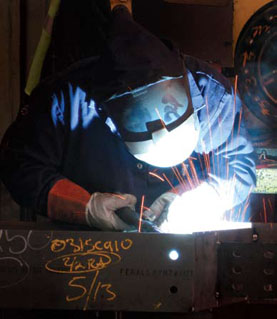
“Some specialized people such as our hand welders have undergone up to 24 hours of training just specifically on correctly reading our fabrication drawings. That’s in addition to being fully certified in the American Weld Society and the Canadian Weld Bureau. We produce buildings here both for the U.S. and Canadian markets.”
Environment & Geography
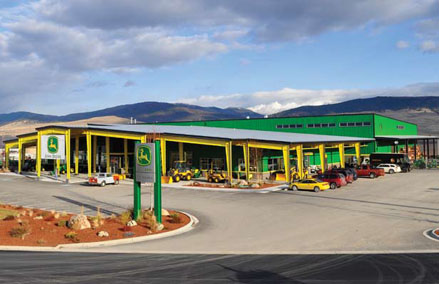
Another aspect of safety, one that is gaining momentum all over North America and especially where the Visalia plant is located, has to do with the environment. Visalia is located in the San Joaquin Valley, and more importantly,in the San Joaquin Valley Air Pollution Control District, which according to Wilson has some of the strictest environmental regulations in the world. The location remains desirable as the Visalia plant is within 300 miles of a majority of the company’s WestCoast customers, but some adjustments had to be made to stay ahead of the environmental curve.
 That meant adding a thermal oxidizer to eliminate the VOCs associated with the production of the painted steel components.
“We believe this is the first plant in the metal building industry to utilize a thermal oxidizer to lower our emissions. We invested in a direct-fire thermal oxidizer—the first in our industry—so we’re basically destroying all the VOCs from our paint system. The net effect of that and some of our other initiatives is that we’re going to reduce our carbon footprint dramatically,” noted Wilson.
The BlueScope Buildings facility in Visalia, combined with another located inArlington, Wash., allows the company to effectively blanket the West Coast with locally made products reducing freight costs and, of course, lead time.
“As the western operations manager for BlueScope Buildings, my responsibility is to produce a product for the western region of the United States—essentially west of the Rocky Mountains. From California, Arizona, up through Canada and into Alaska. We also ship to Hawaii, Guam, Midway Island and some of the military installations in the Pacific. Our goal was to be close to our customers,and I know that freight is an important part of the cost of the building system, so we wanted to be nearby,” said Wilson.
“This facility in California is within 300 miles of a majority of our customers; and our other facility [in Arlington] is within 500 miles of the core business in that market, and that meets our goals. Our goal is to be within 500 miles of our customers, anywhere in the North America. We made a commitment in the West Coast—we wanted to be close to our customers, and that’s a little different than some of the pre-engineered building folks have done. We’re committed to the West Coast market—both out of Washington and California—and I don’t believe any competitor can match that.”
Finan agreed: “With our ten manufacturing locations throughout North America, we feel we have the best geographical footprint in the industry. We firmly believe that construction is a local business, and you have to be in those markets to meet those local needs.”
 Looking Forward
Given the activity at BlueScope Buildings during a challenging market, you might think it’s just sitting back, waiting for the economy to change, and then capitalize with its multibrand strategy. You’d be wrong. BlueScope Buildings is constantly looking toward the future, targeting emerging markets and future needs of the industry.
“We see future opportunities in markets like alternative energy and sustainable construction.The use of BIM technology along with the Vision Engineering System will help us gain access to these markets,” said Finan.“We feel we’ll be in a position to take some market share.
“The other thing we’ve done is lead the industry in product innovation. Here in Kansas City [Mo.] we have the capability to take roof and wall assemblies, put them in a large scale thermal metering device, and precisely measure energy usage. This enables us to develop better products for the building envelope. We’re investing in those areas where we see that the market opportunities will emerge, and that’s certainly in more energy efficient buildings.”
Not surprisingly, in the face of a challenging year to come, BlueScope Buildings is finding a way to improve upon its industry-leading position, once again staying ahead of the curve.
BlueScope Buildings North America
Kansas City, Missouri