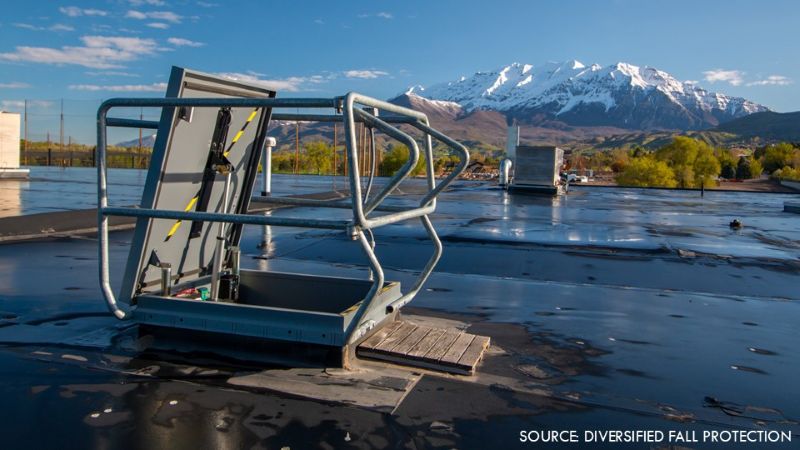
Roof access comes in many forms, depending on how a facility is initially designed. The most common forms are internal stairways leading up to a secure roof access point, exterior fixed ladders ascending the side of the building, or internal ladders leading up to a hatch door.
Roof hatch access systems are convenient for the building developer and are considered less intrusive to rooftop equipment layouts, but pose certain risks for workers who use them to access the rooftop.
This article will describe the various fall hazards presented by roof hatch systems, OSHA’s requirements to provide fall protection, and simple solutions for mitigating risk and protecting workers.
OSHA fall protection for roof hatch systems
Unlike many common rooftop fall hazards, hatches are specifically called out by OSHA, and employers must ensure workers are protected from falls when using them.
According to OSHA 1910.28, Duty to have fall protection and falling object protection, employers are required to provide a “hinged floor-hole cover” and guardrail to protect employees from falling through the hatch when it is open. When the guardrail must be removed to accommodate a work operation (materials are being passed through the open hatch, for example), then employers are required to provide a travel restraint or personal fall arrest system to protect workers from the exposed opening.
Roof hatch fall protection solutions
Railing kits
Roof hatch safety railing kits are a common and affordable solution for mitigating risk to roof hatch operators. They can be easily installed directly into the hatch door and often include a self-closing swing gate that allows easy access to the hatch area while simultaneously creating an enclosure around the hatch.
Fall restraint systems
As previously stated, some work operations may require removing the hatch guardrail to allow material to pass through the hatch door. Workers will be more exposed to hazards during these tasks and must be protected from falling into the hatch.
Fall restraint systems are an effective way to prevent falls when the guardrail is removed. These systems require a fixed-length lanyard or other device connected to a nearby anchorage. As long as the anchor is installed a distance greater than the length of the lanyard, the worker’s movement is restricted enough to not allow them to fall through the open hatch.
However, these systems limit worker mobility and can compromise productivity. This is why many employers decide to use personal fall arrest systems instead, since both solutions are deemed equally compliant with OSHA requirements.
Personal fall arrest systems
Personal fall arrest systems are more commonly used by workers but pose a greater overall risk to the user. Fall restraint systems prevent falls, while personal fall arrest systems do not. Fall arrest equipment simply provides a means to limit the free-fall distance and the amount of force a worker experiences during a fall.
Minor injuries can still occur during fall arrest, but if the wrong connection device is used or harnesses are not properly adjusted, workers can face significant injury. In fact, a 2021 study conducted by the Center for Construction Research & Training (CPWR) found that nearly 60% of fatal falls occurred while the user was wearing fall protection equipment!
Whenever personal fall arrest systems are used, it is important to consider the anchorage location when selecting the appropriate connection device, such as a lanyard or self-retracting lifeline (SRL).
Whenever anchorages are located beneath the user’s dorsal D-ring, Class 2 SRLs must be provided to the worker. Unlike Class 1 SRLs, which are designed exclusively for overhead anchorage, Class 2 SRLs have additional shock-absorption capabilities that make them specifically equipped to handle lowered anchorages and sharp edges.
Since rooftop anchorages used during hatch operations will likely be located beneath the user’s dorsal D-ring, Class 2 SRLs will be necessary. Failing to do so could lead to equipment failure and increase the chance of significant injury to the worker.
Fixed ladder safety
Once the rooftop hatch fall protection solution is implemented, building owners must also consider the safety of the worker when climbing up or down the fixed ladder to reach the hatch door.
As of 2018, OSHA requires all permanent fixed ladders 24 feet or greater (20 feet or greater in California) to be equipped with a ladder safety system or personal fall arrest system. Ladders of that height installed before 2018 have until 2036 to be retrofitted to remain OSHA-compliant.
However, it would behoove companies to not wait until 2036 and retrofit as soon as possible to prevent injuries or fatalities.
Further risk during opening and closing
An open hatch door, or climbing up and down the fixed ladder while accessing the hatch, both pose hazards for rooftop workers, but those are not the only risks involved with operating hatches.
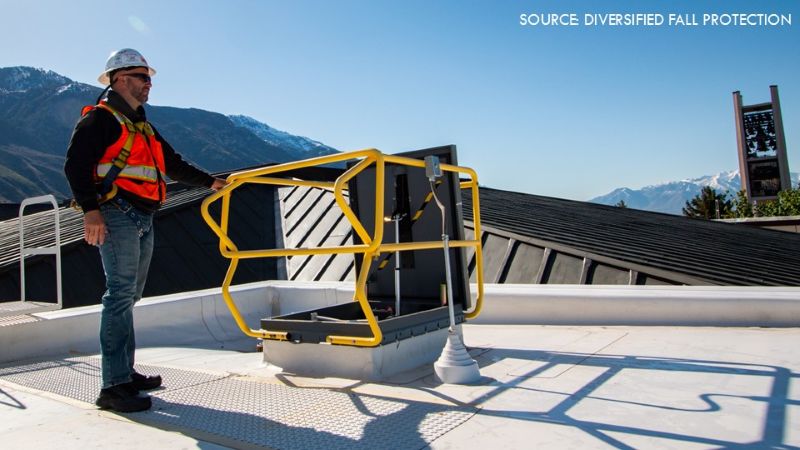
Opening and closing the hatch door is a common precursor to a fall, as users must take at least one hand off the ladder to operate the hatch. Additionally, the extreme contrast between the interior ladder leading to the hatch and the rooftop’s brightness can disorient workers, making them more prone to accidental falls.
For this reason, safety-conscious owners are installing automatic roof hatch openers that can be operated from both above and below the roof hatch. These systems make operating a hatch safer in two key ways. First, the worker does not have to remove their hands from the ladder to open or close the hatch. Second, keeping the hatch open during their climb will better illuminate the ladder area and increase visibility while climbing up or down.
Risk, complacency, and forward thinking
Roof hatches are a commonly used piece of equipment for roof access, and it precisely their commonality that makes them an underrated source of risk. Workers can easily develop complacency when using familiar equipment and, over time, can underestimate the risks involved in using it.
From falling into an open hatch, accidentally slipping from a ladder, or compromising balance while opening/closing the hatch, there are many ways operating a simple roof hatch can expose workers to significant injury … or worse.
OSHA specifically requires employers and building owners to provide fall protection to workers around hatches, skylights, or unprotected roof edges. Before rooftop work begins, crews should survey the area to ensure the proper protections are in place, and consider whether any additional precautions are necessary.
Many guardrail solutions are available prefabricated, but crews are allowed to erect their own guardrail so long as it complies with OSHA 1910.29 specifications.
Every fall is preventable when workers are given the proper resources and training to mitigate the risk. A few simple additions to an existing roof hatch system will not only ensure a business remains compliant with OSHA requirements, but also protect workers from avoidable tragedies.
Philip Jacklin is continuing education program manager for Diversified Fall Protection. As a Qualified Safety Sales Professional (QSSP), his understanding of standards and regulations enables him to properly specify and recommend safety equipment, matching the right system to the application. Philip is also an AIA continuing education provider and has completed advanced jobsite safety training through OSHA-30.