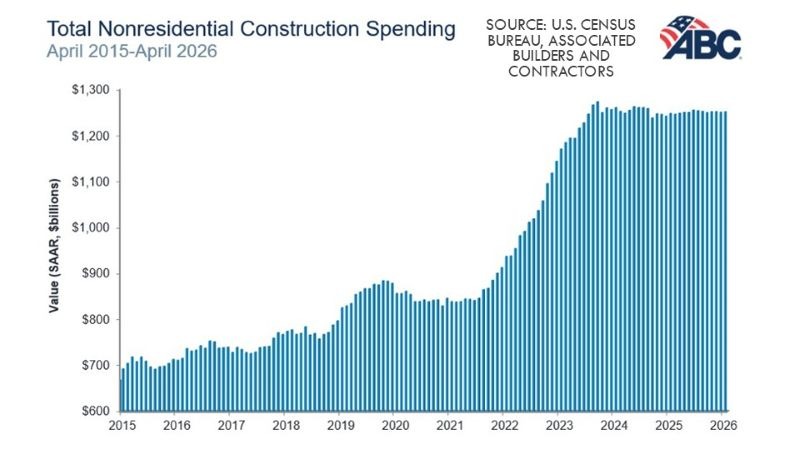
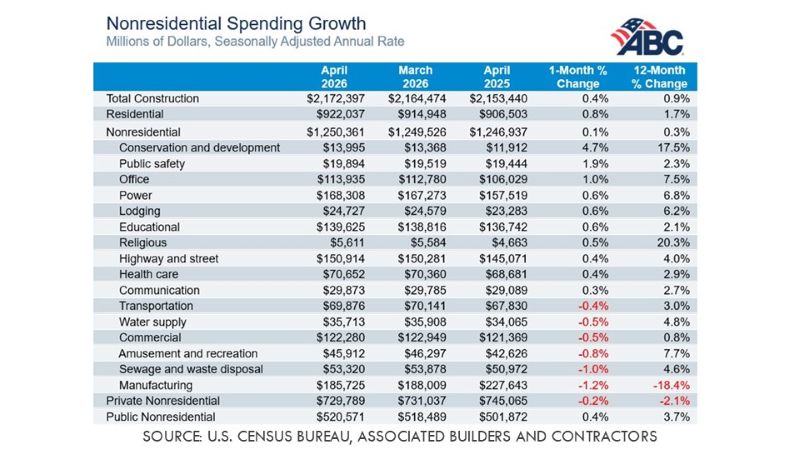
Nonresidential construction spending increased 0.1% in April 2026, according to an Associated Builders and Contractors analysis of U.S. Census Bureau data.
On a seasonally adjusted annualized basis, nonresidential spending totaled $1.250 trillion.
Spending was up on a monthly basis in 10 of the 16 nonresidential subcategories. Private nonresidential spending was down 0.2%, while public nonresidential construction spending was up 0.4% in April.
Spending on data centers, which is included in the office category, increased another 1.9% in April, rising to a seasonally adjusted annual rate of $50.7 billion, and is up 28.1% over the past year.
“Nonresidential construction spending inched higher in April, but that growth was entirely due to a sizable increase in public sector activity,” said ABC chief economist Anirban Basu. “Private nonresidential construction spending fell for the seventh consecutive month and is down nearly 8% from December 2023’s all-time high.”
“While much of the segment’s recent weakness is attributable to the rapid decline in CHIPS* Act-incentivized manufacturing megaprojects, private sector construction momentum has been difficult to find outside of the still-ascendant data center segment,” Basu continued.
* Creating Helpful Incentives to Produce Semiconductors a.k.a. CHIPS and Science Act.